A personal planner
Each patient gets a link that opens to their own plan: every step as a clock time, a live countdown, a "can I eat this?" checker, drink trackers and reminders in their calendar. No app and no login.
Open the example plannerWe turn your clinic's prep instructions into a personal planner, a short explainer video and a clear printed guide. In your brand, signed off by your team, so fewer patients arrive unprepared.
For day surgeries, day hospitals and endoscopy units. Starting with bowel prep for colonoscopy.
Margaret is 68 and first on Thursday's list, at 7:00 am. Her handout is two pages of small print, and every word of it is correct.
7 daysbefore
It says to talk to her doctor about warfarin a week ahead. She reads that far on Wednesday night.
11:00 amWednesday
One is for morning lists, one for afternoon. She follows the afternoon one by mistake and has a light lunch.
2:00 pmWednesday
Does the milk in her tea count? The answer is in a table on page two.
9:15 pmWednesday
The clinic closed at five. She keeps going and hopes she has it right.
2:30 amThursday
The handout says to take it four and a half hours before her admission time. She does the sum twice, half-asleep.
7:00 amThursday
The procedure is cancelled, or goes ahead with a poor view and has to be repeated. Either way, a slot on your list is lost.
None of this is Margaret's fault, and nothing in her handout is wrong. It was written to be clinically accurate. It's read at the kitchen table, tired and anxious, often by someone managing prep for somebody else.
Use your own numbers. Nothing you enter leaves this page unless you choose to send it to us.
Prep not done properly, the wrong food, or a missed medicine step. Your best guess is fine.
arrive not ready. With clearer prep, 3 of them could be.
Colonoscopies, or whichever procedure needs the most prep.
A cancelled or repeated slot, plus wasted staff and theatre time. Not sure? Use your average revenue per procedure.
Your assumption. A pilot measures the real figure.
Today, about 240 patients a year arrive unprepared. At $800 each, that's about $192,000 a year.
Could come back to you each year
$61,300
Fewer unprepared patients a year
72
Staff hours back a year
62
A typical pack pays for itself once it helps 15 patients a year prepare properly. At your numbers, that's about 1 in 16 of the patients who arrive unprepared today.
Estimates only, from the numbers you entered. Dollar figures are rounded.
Your team signs off one plain-language version of your instructions. Everything is built from it, so when a time changes, it changes everywhere.
Rewritten in plain language, every step tied to a day and a clock time. Signed off by your clinical lead, with a version date.
Each patient gets a link that opens to their own plan: every step as a clock time, a live countdown, a "can I eat this?" checker, drink trackers and reminders in their calendar. No app and no login.
Open the example plannerTwo to four minutes of clear motion graphics, with captions and a natural voiceover, for patients who'd rather watch than read. The example runs 3 minutes 43 seconds.
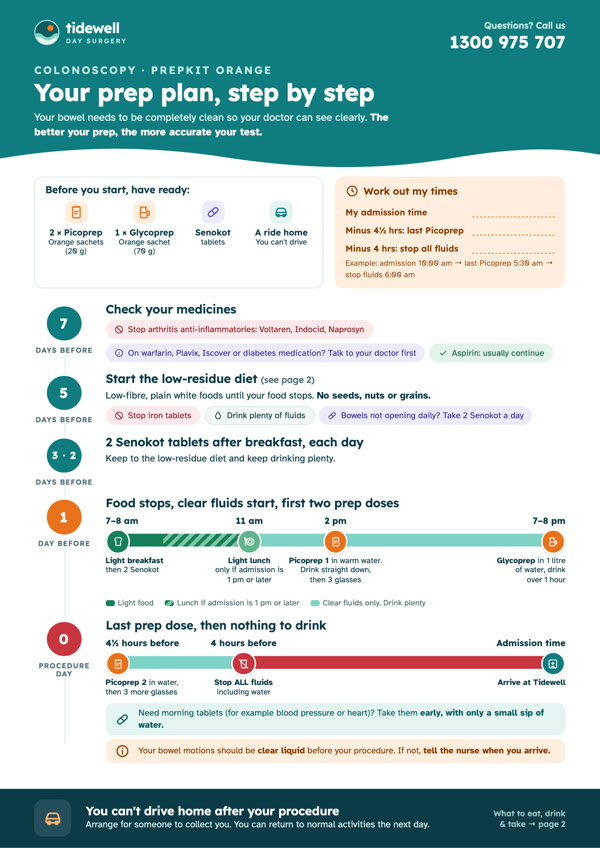
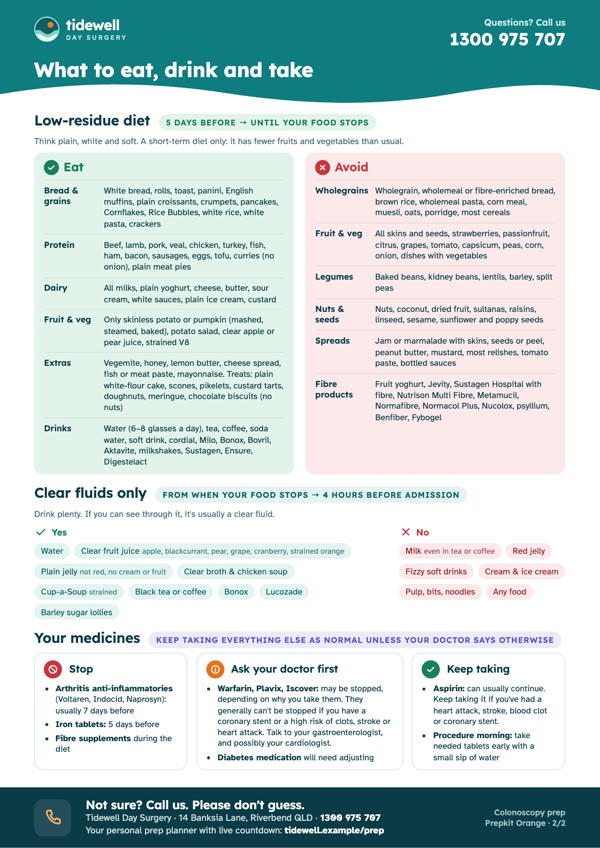
Two pages: the timeline on one, food, drinks and medicines on the other, with boxes for the patient's own times. For the fridge, the waiting room and anyone who prefers paper.
Open the example guide (PDF)The examples are for Tidewell Day Surgery, a fictional clinic. Your pack follows your instructions and your brand.
About five weeks from your handout to launch.
Week 1
A PDF, a Word file, a photo or a link. Every version you use.
Weeks 1 to 2
We remove repetition, turn rules into steps with clock times, and flag anything unclear for your team to decide.
Week 2
Nothing goes live until your clinical lead approves a dated version.
Weeks 2 to 4
Planner, video and printed guide, plus any languages and formats you choose.
Week 5
At booking, and again a week before. We train the team and keep everything current.
Within two business days, you'll get:
It's yours to use, whether or not we work together. If it looks useful, we'll offer a 20-minute walkthrough of your instructions as a working planner.
We've sent a confirmation to . Expect your review within two business days.
While you wait, open the example planner on your phone.
Start with one procedure. We measure against your own figures from the three months before, and agree what success looks like before anything goes live.
No. Each patient gets a link by SMS or email that opens their plan in the phone's browser. There's nothing to install and no account to create.
Not by default. The appointment time travels in the patient's own link, and anything they tick off stays on their phone. If you'd like reminders or reporting that need data, we agree how it's handled with you first.
You are. We rewrite for clarity and flag anything ambiguous or contradictory, and your clinical lead signs off each dated version before it goes live. We never change what your instructions say.
The printed guide covers them, with boxes to fill in their own times. SMS reminders and a phone line that reads out the next step are options too.
We started with bowel prep for colonoscopy. The same approach suits gastroscopy, day surgery fasting, imaging with contrast, eye-drop schedules for cataract surgery, and procedures that need medicine changes beforehand.
Staff can send a personal link in seconds from any system today. Sending automatically from your booking or SMS platform is something we scope with you, system by system.
Tell us what's changed. We update the approved version, your team signs it off, and the planner, guide, video captions and translations all update together with a new version date.
It depends on the formats and languages you choose. Most clinics start with one procedure, and we quote after the free review, once we know what your handout needs.
Orbi Labs, a studio that makes video, design and digital tools. We built the complete Tidewell example (planner, video, printed guide and brand) ourselves.